Tuning into the Library of the Cosmos. The Akashic Records

The Memory of the Soul and the Wisdom of the Universe. We live on multiple planes, planes of consciousness and energy. To begin a new understanding of a reality that has always existed, and that, like much necessary wisdom, has for centuries been suppressed or ignored, if not ridiculed. The word akasha comes from Sanskrit and is linked to concepts like space or ether.
The interpretation of Akasha is that of a record of events of all the souls that inhabit the Universe.
Tuning into the Library of the Cosmos: The Akashic Records and the Awakening of Consciousness.
Have you ever felt an inexplicable certainty when meeting a stranger, an unstoppable impulse toward a talent you've never practiced, or a deep longing for a historical period that doesn't belong to you? Perennial wisdom holds that these sensations are not mere coincidences of the mind. They are subtle echoes of an invisible archive that remembers absolutely everything.
Imagine a living, ethereal library that breathes in unison with the cosmos. In this quantum web, there are no paper books, only light frequencies. There, the electromagnetic imprint of every thought expressed, every emotion felt, every word spoken, and every experience lived by your soul throughout its evolutionary journey through time is stored.
Helena Blavatsky and her Hermetic knowledge.
One of the key figures for understanding the background of the Akashic Records is Helena Petrovna Blavatsky - 1831-1891 - co-founder of the Theosophical Society.

In works like Isis Unveiled - 1877 - and The Secret Doctrine - 1888, Blavatsky studied and explained that the visible reality is only a part of a much broader existence. Her thinking combined elements from various philosophical traditions: Blavatsky's contribution opened up a field of reflection that other authors would develop later.
Rudolf Steiner: The Spiritual Chronicle of Humanity.
Another of the big names linked to this tradition is Rudolf Steiner - 1861-1925, philosopher and founder of anthroposophy.
In his work The Akashic Record, also known by its English title Cosmic Memory, Steiner presents his spiritual conception of humanity.
From his perspective, history is not limited to the events that can be reconstructed through documents, monuments, or testimonies, but also has a spiritual dimension that can be investigated through faculties of supersensible knowledge.
Steiner believed that the inner development of the human being could expand their understanding of reality and open new forms of knowledge.

Your proposal is not limited to asking what happened in the past. It also explores the meaning of human evolution within a broader spiritual process.
This perspective introduces a particularly interesting question: if human life is part of an evolution that does not end with physical existence, how can we understand our individual experience within this journey?
For Steiner, spiritual knowledge requires inner discipline, development of perception, and a conscious transformation of the person.
His ideas are one of the most influential developments of the so-called Akashic chronicle.
Edgar Cayce. The destiny of the soul and experiences from other lives.
During the 20th century, the American Edgar Cayce - 1877-1945 - played a key role in popularizing the idea of the Akashic Records.
Known as the sleeping prophet, Cayce conducted readings while in trance states during which, according to testimonies preserved by his collaborators, he provided information related to health, personal life, spirituality, and experiences from other incarnations.
In many of these readings, the idea appears that the soul's experiences are not limited to a single life. Decisions, relationships, and learnings would be part of a broader evolutionary journey.
From this perspective, the Akashic Records would allow one to understand certain patterns that repeat throughout life and explore the spiritual meaning of certain experiences. ...

The importance of Cayce also lies in the shift in focus he introduced in the popular interpretation of the concept. Universal memory ceased to be just a matter related to cosmic history and became directly linked to each individual’s spiritual biography.
His readings and teachings are preserved through the Association for Research and Enlightenment, an organization founded in 1931 to preserve and spread his legacy.
In Cayce’s thinking, we find an invitation to view life from a broader perspective: our experiences could take on a different meaning when we consider them part of a process of learning, responsibility, and inner growth.
Linda Howe: a contemporary approach to the Akashic Records
If Steiner and Cayce represent two fundamental stages in the modern history of the Akashic Records, Linda Howe is one of the best-known authors in their contemporary application.
Her book, How to Read the Akashic Records: Accessing the Archive of the Soul and its Journey (2009), published in Spanish under titles that may vary depending on the edition, offers a structured method for approaching this practice.

Instead of seeing the consultation solely as a search for answers about the future, your approach invites exploring the dynamics that influence our present life.
Which experiences seem to repeat themselves? What beliefs shape our decisions? What can we learn from certain relationships? How can we act with more awareness and responsibility?
These questions allow you to take your interest in the Akashic Records into the realm of self-knowledge.
Howe's contribution has helped make this tradition accessible to an international audience, offering a practical framework for those who want to explore it from a spiritual perspective.
What does it mean to access the Akashic Records?
Within the different schools that work with this concept, there isn’t a single universally accepted method.
Some traditions turn to prayer, meditation, and contemplation. Others use specific preparation and opening procedures, followed by questions aimed at understanding certain aspects of life.
In general terms, the practice usually starts with a moment of reflection. The goal is to calm the mind, reduce distractions, and set a clear intention. ...
Below, questions are posed that allow exploring a situation, a relationship, or a personal pattern. The impressions that arise can be expressed through words, mental images, intuitions, or symbolic associations, depending on each practitioner's experience.
Finally, the session is closed, and reflection takes place on what was experienced.
For those who follow this tradition, the goal shouldn't be to foster a dependence on consultations, but to develop a deeper understanding of oneself and the decisions that guide one's life.
A well-formulated question can be more valuable than an indiscriminate search for answers.
Instead of just asking what will happen, we can ask ourselves what we need to understand, what responsibility we need to take on, and what possibilities we have to act differently.
Ervin Laszlo and the Universe's information field.
The relationship between consciousness and information is another aspect that sparks interest in contemporary reflections on the Akashic Records.

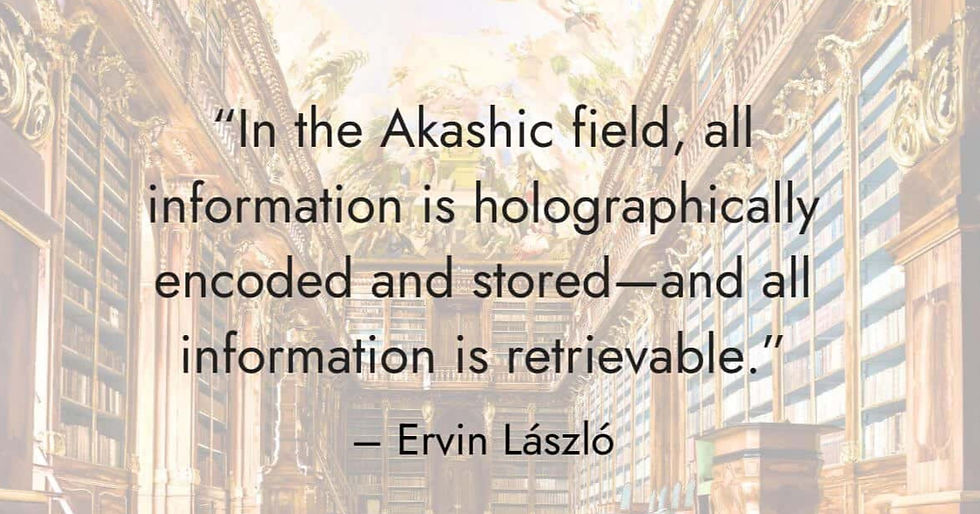
The philosopher of science Ervin Laszlo has developed a proposal known as the Akashic field, presented in his book Science and the Akashic Field: An Integral Theory of Everything - 2004.
Laszlo puts forward an integrative vision of the universe in which information plays a fundamental role. In his interpretation, a deep informational field would help understand the connection between natural phenomena and the evolution of the cosmos.
Ervin Laszlo has been nominated for the Nobel Peace Prize and is the founder of the Budapest Club, an international organization dedicated to promoting a global and comprehensive vision of humanity and its future.
An invisible library on the horizon of consciousness.
The image of a universal library exerts a powerful fascination on the human imagination.
In it, every existence would be a story, every encounter an opportunity to learn, and every decision a new possibility within the journey of consciousness.
Perhaps that's why the Akashic Records continue to spark interest in people seeking a deeper understanding of their life and their place in the universe. From Blavatsky's theosophy to Steiner's spiritual research, Cayce's readings, Linda Howe's method, and Laszlo's philosophical proposal, we find different ways to approach the knowledge and depth of the meaning of the Akashic Records.