More Human Cities.
- Editorial

- Aug 17, 2025
- 3 min read
In the post-industrial transition, a highly attractive and interesting opportunity has been araised, both for citizens and for the most innovative architects and creatives, in the development of new city concepts. The challenge is doubly appealing, as it allows, on one hand, to adapt urban centers to more human lifestyles, and on the other hand, to create absolutely beautiful and innovative structures.
Post-industrial cities.
The term post-industrial was first used by American sociologist Daniel Bell in his book The Coming of Post-Industrial Society published in 1973.Post-industrialism involves the transition from manufacturing goods to providing services, which entails the replacement of workers with administrative staff and specialized professionals in various areas of each service.Post-industrial cities languish and do not contribute to the new models of living that are not reflected in the boredom of post-industrial cities.:
Deindustrialization:
The loss of traditional industries can leave the city with an economic and cultural void, affecting employment and local identity.Lack of investment in public spaces:The lack of parks, squares, and cultural centers can reduce opportunities for social interaction and recreation.
Urban homogenization:The proliferation of chain stores and the lack of distinctive architecture can make cities feel generic and uninteresting.
Uncontrolled urban expansion:
Suburban growth can lead to urban fragmentation and a lack of social cohesion, with residential areas far from urban centers.
Migration of youth and talent:
Cities that do not offer attractive opportunities can lose their younger and more creative population, which can affect their vitality and dynamism.Lack of identity and local culture:The loss of traditions and the lack of spaces for cultural expression can contribute to a feeling of rootlessness and boredom.
Post-modern values.
The changes in social scenarios bring about a change in values, referred to as post-modern. These new values can be defined according to the European University UNIC, "as a major urban renewal: urban agriculture, vertical gardens, parks and green spaces, sports and leisure, pets, integrated urban transport, the construction of environmentally-friendly housing, reduction of air pollution, noise reduction, environmental protection, production of healthy food, management of the visual and built environment, co-creation of culture, community art."

Conscious Architecture.
Frank Lloyd WrightFrank Lloyd Wright is a historical figure for all architecture graduates. He developed his then very revolutionary concepts in the 1920s, recognized for the use of natural materials, generally in their original forms, a key element of the building. For him, attention and respect for the local environment imply paying attention to the use of materials, maximizing natural light, functionality, and sustainability to minimize impact on the environment. His designs prioritized ventilation and natural lighting to make them sustainable and economical, potentially providing heating and cooling. Many consider his works relevant today due to these sustainable factors. He believed that, to be sustainable, nature, people, and built structures needed to support each other and thrive together.
"Study nature, love it, stay close to it. It will never fail you."

The House of the Waterfall is a magnificent example of its organic architecture, which seems to naturally be part of the environment, rather than integrated into it. In this way, the house, along with its occupants, harmoniously integrates with the natural surroundings.
Michael Reynolds
Michael Reynolds founded Earthship Biotecture, which designs energy-efficient buildings using waste materials.Its principles are simple: a harmony between function, design, and environment, without glimpses of grandeur. The projects, generally known as Earthships, are built with natural and recycled materials. Designed to be sustainable, all designs incorporate several, if not all, of the principles of Earthship Biotecture, which can function anywhere in the world.

Architecture should focus on people and the planet, and nothing else.
Futuristic designs towards a new era.
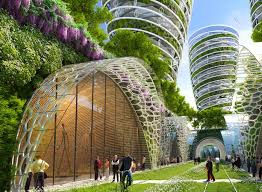
Young architects explore bold new concepts that unite technology, green environment, and humanity.

The world will be green, or it will not be. Humanity must reconcile and live with nature, uniting technological advancement with sustainability, but also, with Humanity. A more spiritual, more sustainable, more human land.


Blibliogray:
Cities and Nature. John Rennie.
Invisible Cities. Italo Calvino.
Creating Great Places. Debra Flanders.Ivonne Miller.